The question is whether your kid believes your love is a paycheck he clocks in for. My answer: a child's standing in your home is settled and non-negotiable, and the rules in that home stay loud — two separate ledgers that good fathers refuse to merge. Correction addresses what he did; belonging addresses who he is, and it never goes on the table as collateral.
You know the face. You correct your kid, and something drops behind their eyes — not fear exactly, more like a tally board updating. Every dad has watched it happen and felt his stomach turn.
Here's the question under it, and it's worth sitting with: does my child believe my love is a paycheck they clock in for? Because a kid who thinks affection gets earned will spend thirty years trying to earn it — from you, from God, from everybody.
Works-righteousness has a plain definition: your standing with God gets earned by what you produce. Pelagius argued a version of it in the fifth century, Augustine took it apart, and the church has relitigated it every generation since. Luther spent his early years grinding at it — confessing for hours, never arriving — until he read Paul and realized the standing came first. The verdict of serious Christian thinking has been remarkably consistent: a man cannot buy what has already been given to him.
Now run that same engine at a kitchen table. Nobody announces it. No dad stands up at breakfast and declares that affection is a performance-based bonus structure with quarterly reviews.
The transmission happens through the thermostat. Warmth climbs when the report card is clean and the room is picked up. Warmth drops — not yells, just drops — when the kid melts down in the cereal aisle or lies about the broken lamp. A child does not need the doctrine explained. He reads the data over a few thousand repetitions and builds the theology himself: love is a wage, and he is behind on hours.
That is works theology with a congregation of three, and it catechizes harder than any Sunday school ever will, because it runs seven days a week in the house where he sleeps.
Here is the position this whole piece defends. A child's standing in your home is settled, permanent, and not available for renegotiation based on behavior — and the rules in that home stay loud, enforced, and inconvenient. Those are two separate ledgers, and good fathers refuse to let them merge. Correction addresses what a kid did. Belonging addresses who he is, and it never goes on the table as collateral.

The bill comes due in four ways, and none of them look like rebellion at first. The first is anxiety — the low-grade hum of a kid who can never confirm he's current on payments. Psychologists have a name for the condition this creates: socially prescribed perfectionism, the belief that acceptance depends on hitting someone else's standard. Decades of research link it to anxiety and depression in adolescents, and pastors have been counseling the grown version of it forever — adults who can recite that they're forgiven and cannot feel it for ten consecutive minutes.
The second is concealment. A child who believes his standing is on the table will manage what you know about him, because that's the rational play. He doesn't report the failed quiz. He hides the dent, blames the sibling, gets very good at the edited version. That's not a character defect blooming — that's a kid protecting his position in the only way the system allows.
The third is performance. This one fools dads, because it looks like success walking around the house. The kid reads the room, delivers the answer you wanted, and keeps the actual self somewhere you can't reach it. You didn't raise an obedient son. You trained a skilled negotiator who happens to be nine.
The fourth is the quit. Mueller and Dweck put this on the record in 1998: children praised for being good rather than for effort chose easier tasks afterward and folded faster when they hit something hard. If the scoreboard never resets, the smart move is to stop playing. That's the fourteen-year-old shrugging "I don't care" — which is almost never true and almost always armor.
So the earning cycle doesn't just hurt a kid. It fails on its own terms. You installed it to manufacture good behavior, and it reliably produces hiding, acting, and surrender instead.
I didn't invent that thermostat. I inherited it, and then I ran it on God for years. Mine didn't look like doubt from the outside. It looked like effort — cleaner mouth, better week, more discipline, a running tally of whether I was current on what I owed Him. On the good weeks I felt close. On the bad ones I kept my distance from God the way a man avoids a creditor he can't pay.
That's not a relationship. That's an account, and the interest never stops compounding. I didn't quit the cycle because I got better at it. I quit because I hit the bottom of it — what I've come to call the gift of desperation — and found out the arithmetic never worked in the first place.
What ended it was Ephesians 2:8-9: saved by grace through faith, and even the faith is a gift, not a wage. Standing with God rests on what Christ already did, received by trust, not on my performance review. The ledger wasn't balanced that day. It was closed. Everything good that's come out of me since is fruit of that, never the price of it — and I became a father the same year I buried mine, which is about the loudest way a man can learn that love arrives before you've earned anything.
Somebody will say that's a theology question and has no business in a parenting article. I'd say it's the only question in the article. A father hands down the standing he actually believes he has, not the one he can quote.
You cannot give your kids a grace you're still trying to buy for yourself.
If I'm grinding for acceptance from God, my daughter will feel that engine running in me long before she can name it. The house runs on whatever the man at the head of it believes about his own account.
Grace is not a lower standard. It is a settled standing under a standard that got higher. Paul saw the objection coming in Romans 6 and swatted it in one line: shall we keep sinning so grace abounds? Absolutely not. Bonhoeffer gave the counterfeit a name — cheap grace, forgiveness sold without repentance, comfort without a cross. A father who waves off behavior because "she's loved no matter what" hasn't given his kid grace. He's given her nothing to push against.
Look at what Titus 2 says grace actually does: it trains us to renounce what's destroying us. Trains. That's coach language, not couch language. The gift comes first and then it goes to work on you — which is exactly the arrangement a healthy home runs on.
Here's the mechanic of it. A kid who knows his standing is secure has his full tank available for the task. He isn't burning fuel defending his position in the family, so he can hear "that was dishonest, go fix it" as information instead of eviction. Secure kids take correction better. Terrified kids manage it.
Diana Baumrind mapped this decades ago and the finding has held up. High warmth with high demands produces the best outcomes — self-regulation, resilience, competence. High warmth with no demands produces the permissive home, and those kids consistently land worse on impulse control and follow-through. Warmth alone is half a father.
So when a dad skips the hard conversation, let's call the move what it is. That's not mercy. That's a man choosing a quiet evening over a formed child, and dressing the trade up as love. Permissiveness is conflict avoidance with a better vocabulary.
Acceptance is the foundation. Obedience is what gets built on it. Pull the foundation and the house never stands — but pour a foundation and build nothing, and you've handed your kid a concrete slab in a field and called it a home.
Grace is not a lower standard — it is a settled standing under a standard that got higher. A father who waves off behavior because "she's loved no matter what" hasn't given his kid grace; he's given her nothing to push against. Permissiveness is conflict avoidance with a better vocabulary.
Here's the objection at full strength, because it deserves it. Look around: a generation that can't take a correction without filing a complaint, can't lose a game without a ceremony, can't hold a job past the first hard conversation. Somebody raised those kids on affirmation and nothing else. The argument says consequences are the forge — a boy who never pays for anything learns that nothing costs, and a man who learned that is useless to his wife, his boss, and his country. That's not a strawman. That's largely correct, and any dad pretending otherwise hasn't met many twenty-two-year-olds.
Now watch what the argument smuggles in. It assumes the bite in a consequence comes from the risk of losing you. Take away the chill, the silence, the week of being slightly less of a son — and supposedly the lesson loses its teeth. That's the premise, and it's wrong.
The research on this isn't close. Power-assertive discipline — fear, shame, withdrawal of affection — predicts more behavior problems over time, not fewer. Hoffman and later Grusec and Goodnow found that kids internalize a rule when they understand the harm it caused and still feel safe in the room. Fear teaches a kid to read the enforcer. Explanation plus security teaches him to read the situation. One of those works when you're not there, and you won't be there for most of his life.
So the objection has the right enemy and the wrong target. The soft kids it's describing weren't raised in grace homes. They were raised in homes with no demands at all, where "I love you no matter what" was deployed as a reason to skip the hard conversation. That's permissiveness wearing grace's jacket.
Standing and standards are two different things. The dad who confuses them gives up one to protect the other, every single time — and he always loses the one he was trying to protect.
So what does this look like on a Tuesday night when the lamp is broken and somebody is lying about it? The mechanics matter more than the philosophy here, because a kid reads sequence, not intent. Run the correction in this order and the two ledgers stay separate on their own.
1. Name the deed, never the kid. "You lied about the lamp" does the work. "You're a liar" indicts the person, and a kid can't repair who he is — only what he did.
2. State the standing before you state the consequence. "You're my daughter, that's settled, and here's what happens now." Security first, bill second. Reverse the order and she spends the whole conversation checking her position instead of hearing the point.
3. Make the consequence a repair, not a mood. He apologizes to who he hurt, cleans what he wrecked, works off what it cost. Restitution teaches the shape of the harm. Suffering just teaches him you were mad.
4. Hold your voice at the volume you use for the weather report. Heat signals that the relationship is in play. Flat and immovable signals that only the rule is, and the rule isn't negotiating.
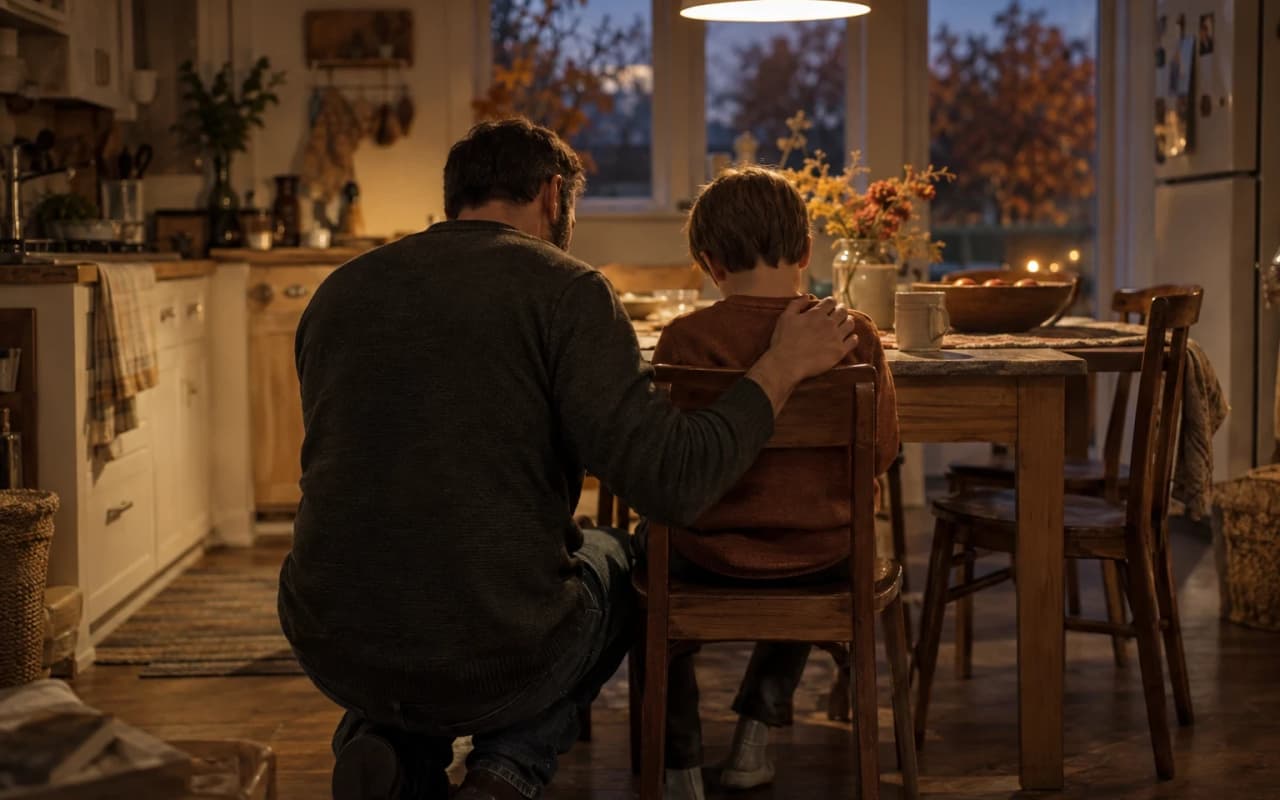
5. Close the loop the same day, every time. Eye contact, arm around the shoulder, "we're good, it's done." Reconciliation is the scheduled ending of a correction, not a prize he buys back with six hours of pleasant behavior.
6. Don't reopen it. Once it's settled, it stays settled — no filing last month's offense as ammunition in next month's argument. A father who re-litigates has reopened the account he just closed.
Most dads handle steps one through four fine and skip five. That's the one that does the teaching. A kid learns what correction means from how it ends, and if it ends in silence, he learns that his place in the house thaws out slowly instead of never freezing at all.

Family devotions earn most of the mockery they get. The standard format is a verse, a leading question, and a kid performing the right answer so he can go play — a quiz with a candle on it. If the table runs like a pop quiz, you've taught grading again, just with better lighting. The fix isn't more curriculum. It's a weekly rhythm where grace gets demonstrated instead of covered.
Ten minutes on Sunday teaches nothing on its own. The week teaches, and when the week and the devotion disagree, every child alive believes the week. The devotion's real job is holding you to what you said.

Some of us didn't learn this at a kitchen table. We learned it in a pew, and it came with Bible verses attached. Guilt-driven faith has a signature move: every event gets a moral tag stapled to it. You didn't break a lamp, you disappointed somebody. You didn't skip chores, you grieved the Holy Spirit. The behavior was never the point. The point was always what the behavior proved about your soul.
That's the habit to kill, and it's the one that fires without your permission. Moralizing is the default program at 9pm when you're tired and the kid has tested you twice. Watch for the sentence that starts with "after everything" or ends with "God sees that." Those aren't corrections. Those are invoices, and you got handed the template before you could read.
Now, somebody's jaw just tightened, because this sounds like putting dad on trial. Honor your father and mother isn't a suggestion, and a man who spends his forties auditing his childhood usually produces nothing but a well-documented grudge. Fair. But honoring a man means telling the truth about him, not building a monument with the hard parts sanded off. Most of those fathers ran the only program they were issued. Naming a defective tool convicts the tool, not the hand that held it.
So here's the step, and it doesn't require a confrontation, a letter, or a reconciliation dinner. Catch the moral tag before it clears your teeth and say the plain thing instead: here's what you did, here's the repair, here's where you stand. The chain breaks at whichever generation notices it — and you just did.
Here's what I believe, and I'll put my name on it. A child's place in your home is settled before he does anything, and the rules in that home stay loud. Those two things don't compete. The first one is what makes the second one survivable.
What convinced me wasn't an argument. It was watching the earning cycle fail in my own life for years — more effort, more discipline, more distance from God on the weeks I came up short. Nothing changed until the ledger closed instead of balancing. Then the change came, and it came as fruit, not as payment. A man who has lived both sides of that doesn't stay neutral about which one he hands his kids.
So run one thing this week. The next time you correct your kid, close the loop the same day — look at them, put a hand on a shoulder, and say "we're good, it's done." Out loud, before bed, every single time.
That's the step most dads skip, and it's the one that does the teaching. Your kid learns what your love is made of by how your corrections end. End them the way grace ended yours.
FAQ
One email a week — only when there’s something new. No spam. No sponsors.
Unsubscribe anytime · Privacy

Working the Holiday: The Silent Sacrifice Dads Make
Missing the fireworks doesn't make you a absent dad — it makes you a provider. Here's how to carry the weight with purpose and stay connected when duty calls.

Am I Aiming at the Right Goals as a Father?
Provision versus presence — which one will kids actually remember.

Prayer as a Parenting Tool: A Beginner Dad's Guide
Real talk: five minutes of prayer a day did more for my parenting than any app, book, or hack ever has.