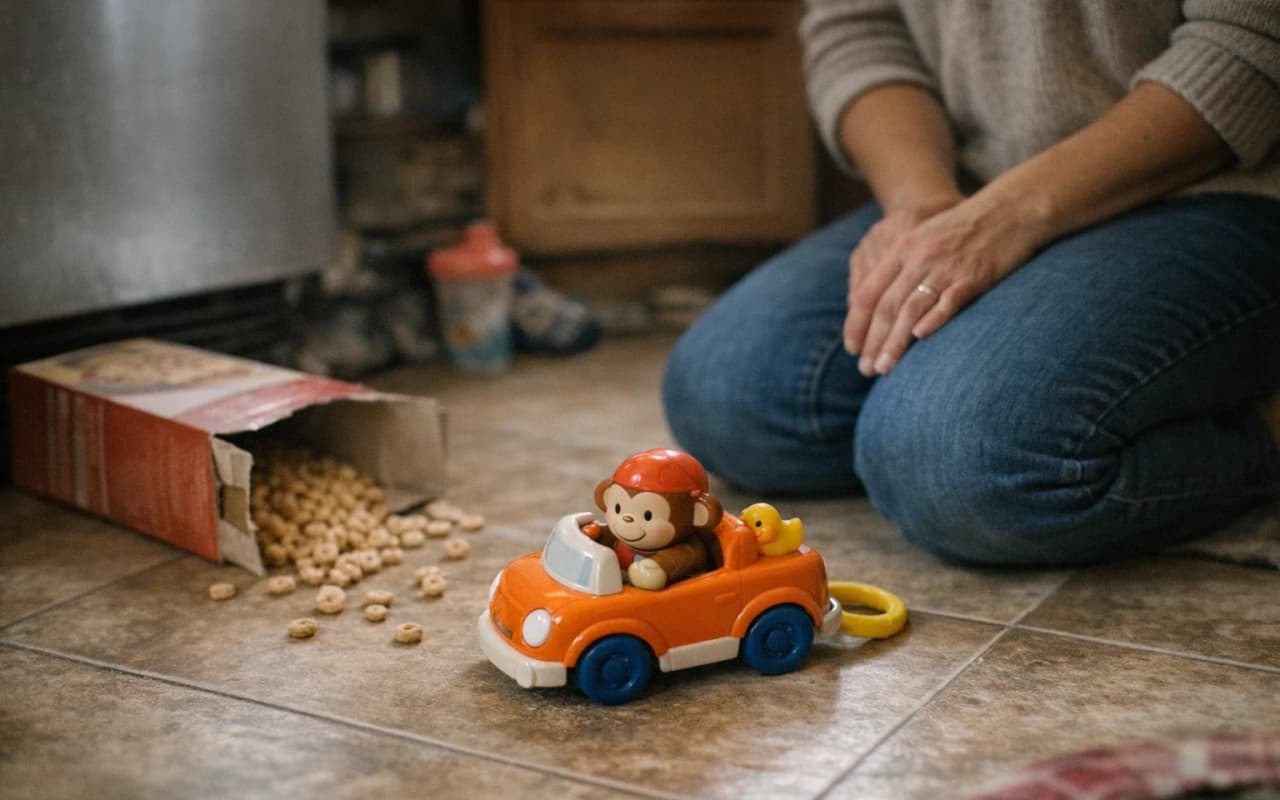
AI-generated scene
Tantrums aren't defiance — they're a skill gap, and this guide shows how to coach a toddler through the feeling instead of punishing the behavior. Name the emotion fast, let the full tantrum play out as the practice rep, then reset with the same boring calm-down ritual every time.
Here's the deal: your toddler is not plotting against you on the floor of the cereal aisle. That meltdown is a skill gap, not a discipline failure — the kid simply doesn't have the wiring yet to handle a big feeling. Punish the tantrum and you miss the lesson hiding inside it. Coach it right, and you're building emotional regulation that pays off for the next eighteen years. That's the whole game here.
Real talk: a toddler screaming on the floor doesn't know what's happening inside their own body. You do. Your job is to hand them the word before you hand them the consequence — "you're frustrated because the toy broke" lands a lot better than "stop crying." Say it flat, say it calm, and say it fast, within the first thirty seconds if you can manage it.
This isn't a feelings-chart poster exercise. Developmental psychologists call this "affect labeling" — putting language on an emotion actually lowers activity in the brain's fear response and helps a kid move from reaction to recognition. You're not soothing the tantrum, you're narrating it. Over months, the kid starts doing it himself: "I mad" shows up before the full floor-slam does, and that's the whole upgrade right there.
Keep the vocabulary small and honest. Mad, sad, scared, frustrated, disappointed — four or five words, used constantly, beat twenty words used never. Skip the lecture. A toddler mid-meltdown has zero bandwidth for a paragraph; he's got bandwidth for one word and your face staying calm while you say it.
And don't confuse naming the emotion with excusing the behavior — those are two different jobs, and the emotion comes first. "You're angry, and we don't throw the cup" does both in one breath without softening either half. You're not negotiating with a tiny lawyer. You're giving him the words so that someday, instead of throwing the cup, he tells you he's angry — and that's the whole point of doing this before you ever touch the behavior part.
Bottom line: the tantrum is the rep. You don't build a muscle by skipping the hard set, and you don't build regulation by rushing past the meltdown to get to quiet. The screaming on the kitchen floor is the actual workout — the only moment where the skill you're teaching has anything real to push against.
Think about what you're asking a toddler to do: feel something enormous, stay in the room with it, and come back down without losing his mind completely. That's the skill. He can't practice it when he's calm, because there's nothing to regulate. He can only practice it live, mid-storm, with you standing there as the floor that doesn't move. Every time you stay steady through the full three or four minutes instead of bribing it to stop at minute one, you're letting him run the actual drill.
That means you don't rescue the feeling — you ride it out next to him. Stay close, stay quiet, keep your face boring. A bored, steady dad is the most regulating object in the room. The second you escalate, negotiate, or cave with a snack to make it stop, you've pulled him out of the rep before his nervous system finished the set, and he learns the tantrum works instead of learns the tantrum ends.
Watch for the downslope — the shift from full-volume to shaky breathing to actual words again. That's the part worth narrating: "You're coming back down, I see it." He doesn't clock it himself yet. You pointing it out is what turns an accidental calm-down into a skill he recognizes and, eventually, can trigger on purpose instead of just surviving by accident.
Here's the deal: a ritual only works if it's boring and repeatable. Pick the same three moves every single time — same spot, same words, same order — so the kid's brain learns the sequence instead of guessing what happens next. Something like: move to the rug by the couch, take three breaths together out loud, then one short phrase like "we're okay, let's talk about it." That's it. Three steps, same three steps, every time, for months.
The spot matters more than you'd think. A consistent calm-down corner — not a punishment corner, a reset corner — gives the body a cue before the mind catches up. Walk there enough times during a meltdown and eventually the kid starts walking there himself when the storm is still building, because the location has become shorthand for "this is where I come back down."
Keep your script short enough to say through gritted teeth on your worst day. If the ritual requires you to be patient and eloquent, it'll die the first week you're running on no sleep. Four words, one phrase, same breathing count — something simple enough to survive a bad Tuesday.
Resist the urge to upgrade it. Dads like fixing things, and a calm-down ritual that "works" tempts you to add steps, add rewards, add a sticker chart. Don't. The power is in the sameness. A two-year-old doesn't need variety here — he needs to know that no matter how big the feeling gets, the next three things that happen are always the same three things.

Bottom line: none of this works if you and your co-parent are running different playbooks. A kid who hears "we don't throw the cup" from you and gets a bribe-snack from mom five minutes later isn't learning regulation — he's learning which parent folds first. Before the next meltdown hits, sit down and agree on the actual words you'll both use and the actual ritual you'll both run.
Start with the vocabulary. If you're using "mad, sad, scared, frustrated" as your four words, your co-parent needs the same four — not a different set that forces the kid to relearn the map depending on who's home. Mixed language isn't a small inconsistency; it's the difference between a kid who can name what he feels and one who's still guessing.
Same goes for the calm-down ritual. The rug, the three breaths, the one phrase — that sequence has to survive the handoff between parents or it's not a ritual, it's a coincidence. Pick a five-minute window this week, no kid in the room, and literally run through it together so you're both saying the same thing in the same order.
Disagreements are fine — have them later, away from the kid, not mid-tantrum where he can hear the crack in the wall. The second a toddler senses daylight between his parents, he stops practicing regulation and starts running an experiment on which adult gives in. Don't give him that experiment to run.

Real talk: sometimes the tantrum isn't the lesson, it's the smoke alarm. Before you run another regulation rep, check the basics — a kid running on eleven hours of broken sleep instead of twelve solid ones doesn't have the nervous system for coaching that day. He's not refusing to regulate. He physically can't.
Diet plays the same trick. A toddler who skipped lunch or just rode a sugar spike down to a crash isn't negotiating, he's crashing. If the meltdowns cluster around the same time of day — pre-nap, pre-dinner, right after a juice box — that's not a discipline pattern, that's a blood-sugar pattern wearing a discipline costume.
Stress hides the same way, just quieter. New sibling, a move, a schedule change, even you being gone more than usual on a work rotation — a toddler can't tell you he's unsettled, so he shows you with his whole body on the kitchen floor instead. Watch for meltdowns that showed up out of nowhere, got bigger instead of smaller over a couple weeks, or started clustering around a specific person or transition. That's not a skill gap. That's a kid trying to tell you something he doesn't have words for yet.
The fix here isn't a better calm-down ritual. It's an earlier bedtime, a snack before the witching hour, or you sitting on the floor asking what's different lately. Coach the emotion when it's really an emotion. Fix the body when it's really the body. Confusing the two just means you're running drills on a kid who needed a nap.
Bottom line: most tantrums fade as the skill builds. A few patterns don't fade — they escalate — and that's your signal to stop coaching solo and loop in a pediatrician. Track the trend, not the single bad day.
Frequency climbing instead of settling is the first one. If meltdowns were three a week two months ago and they're eight a week now, with no sleep regression or life change explaining it, the ritual isn't failing — something else is driving it. A pediatrician can rule out what you can't see from the kitchen floor.
Aggression that targets instead of flails is worth a conversation too. Flailing arms mid-meltdown is normal toddler physics. A kid who starts deliberately hitting, biting, or throwing things at a specific person — especially a sibling — is showing you something past frustration.
Watch for regression on skills he already had locked down. Potty training backsliding, language he'd been using disappearing, sleep that was solid suddenly falling apart alongside the tantrums — that cluster together is bigger than a discipline issue.
Length matters as much as frequency. A toddler who can't find the downslope at all — twenty, thirty minutes with no shift toward calm no matter what you do — is past the normal range for his age.
None of this means something's broken. It means you bring the pattern to someone trained to tell the difference between a rough stretch and something that needs a closer look — and you bring data, not just a worried gut feeling.
Strip away the theory and expert-level coaching comes down to a loop you run the same way every time, without stopping to think about which section of a parenting article you're in. Name it, ride it, reset it. That's the whole sequence, and it takes about as long to run as it does to read this sentence.
Name it means you're the first voice in the room, not the last. The instant you see the wind-up, you say the word — mad, frustrated, scared — before the behavior even peaks. You're not reacting to a meltdown anymore, you're meeting it at the door.
Ride it means you stay boring on purpose. No bargaining, no bribing, no raised voice competing with his. You're the floor that doesn't move, and you let the full rep play out instead of rescuing him from minute one.
Reset it means the same three moves, every time, no improvising. Rug, breaths, phrase — the sequence he can eventually run without you standing there.
Run that loop enough times and it stops feeling like a system and starts feeling like instinct — yours and his. You'll catch yourself naming the emotion before you've even decided to. That's not luck. That's a few hundred reps finally paying off, the same way any skill worth having gets built — slow, repeated, and unglamorous, right up until it isn't.
Here's the reframe, stripped down: the tantrum was never the problem you needed to solve. It was the rep your kid needed to run, with you standing there as the steady part he borrows until he grows his own. Discipline shuts the behavior down. Coaching builds the muscle underneath it, and that muscle is what shows up at eight, at fifteen, at twenty-five, long after you've forgotten the cereal aisle.
You don't need the whole system running by tonight. You need one move. Next time you see the wind-up start, say the word before you say anything else — "you're frustrated," flat and calm, nothing attached to it. That's the first rep. The rest builds from there.
FAQ
One email a week — only when there’s something new. No spam. No sponsors.
Unsubscribe anytime · Privacy
How to Build a Backyard Playset Area Your Kids Will Actually Use
I built our backyard play area from scratch so you don't have to guess. Here's every step — ground prep, safety surfacing, and the add-ons worth adding.
The Dad's Guide to Baby Proofing Your Entire Home in One Weekend
Room-by-room baby proofing plan from a dad who learned some lessons the hard way. One weekend, one checklist, zero regrets.