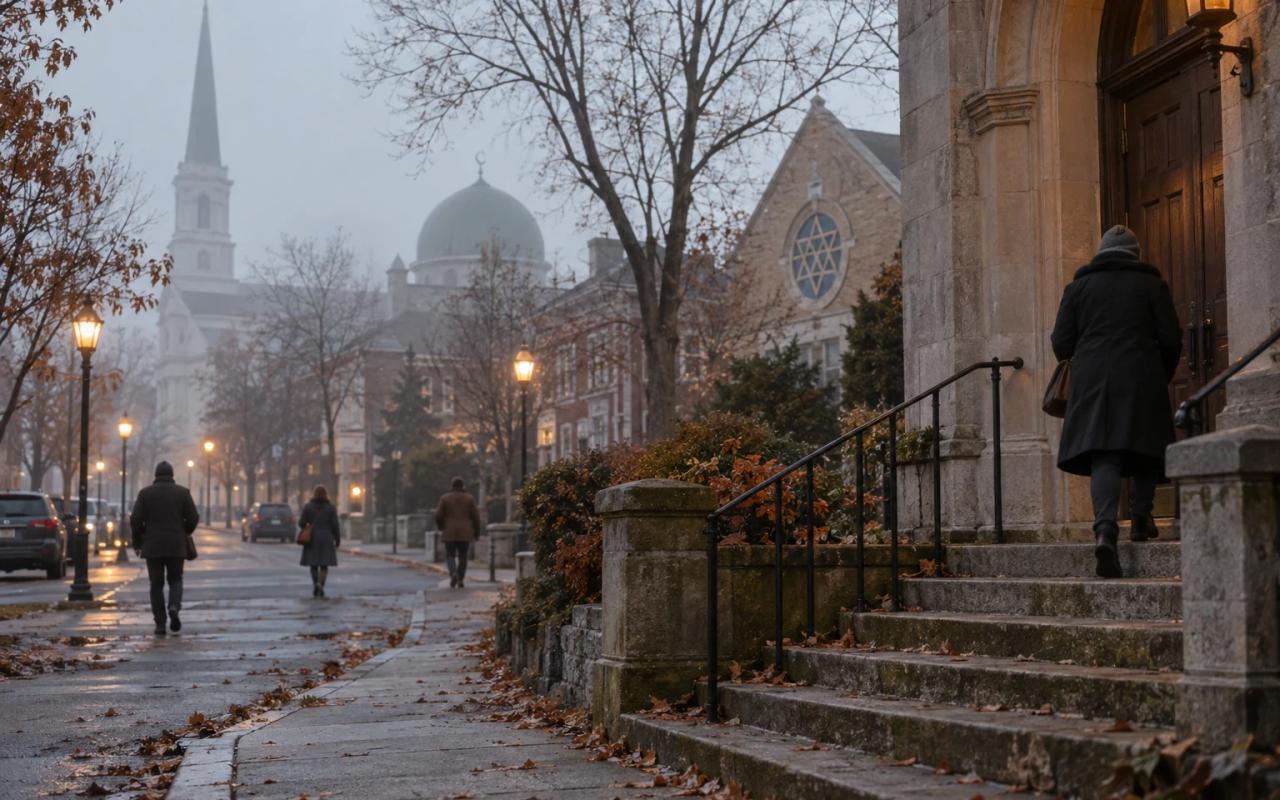
Teaching your kids your faith in a pluralistic country isn't intolerance — rooted beats rootless, and respect for a neighbor's altar never requires loosening your grip on your own. I lay out the First Amendment in kid-sized terms, answer the case against religious upbringing, and give you table questions and a reading list.
My daughter is 19 months old. She hasn't asked me a hard question yet, but the clock is running, and I already know what's coming. Why does that family pray somewhere else? Why does that kid's holiday look nothing like ours?
Here's the deal: I love the Christian culture and values this country was built on, and I intend to hand them to my daughter intact. That's not nostalgia, and it isn't fear of the neighbors. The American founding pulled off something genuinely rare — a country where I raise my kid in my faith, my neighbor raises his in his, and no magistrate gets to settle the argument for either of us.
Somewhere along the line we started teaching children that respecting another man's beliefs means holding your own loosely. That's backwards, and it produces exactly what you'd expect. A kid with no roots doesn't grow up open-minded. He grows up into whatever the loudest room in his life wants him to be.
So here's where I land, and the rest of this is the argument for it: rooted beats rootless, and respect is not surrender.
The whole thing runs on sixteen words. "Congress shall make no law respecting an establishment of religion, or prohibiting the free exercise thereof." That's it. Two clauses, two jobs. The first says the government doesn't get to name an official church. The second says the government doesn't get to stop you from practicing yours.
The kid-sized version fits on one breath: nobody can force your neighbor into our church, and nobody can lock us out of it. That's the trade. You don't get a state religion, and you don't get a state that can shut yours down. Most eight-year-olds grasp that faster than most adults on television.
Here's the part the civics worksheets skip — the men who pushed hardest for this weren't skeptics. They were Baptists. Preachers in colonial Virginia were fined and jailed for preaching without the established church's license, and John Leland and his people wanted that boot off their necks permanently. Madison made the argument in his 1785 Memorial and Remonstrance: a government with the authority to establish Christianity can establish any one sect it likes, and then tell you which. Jefferson's Virginia Statute for Religious Freedom passed the next year. Connecticut kept a state church until 1818. Massachusetts held on until 1833. This was never theory.
So read the second clause the way it's written. Free exercise means exercise — prayed out loud, taught at your table, carried into the public square. The First Amendment is a leash on the government, not a muzzle on you.
Pluralism is a settlement about power, not a verdict about truth. It says the state doesn't get to decide whose altar is the right one. It does not say the question has no answer. Those are two completely different claims, and a lot of people hand kids the second one while calling it the first.
Relativism is the counterfeit. It teaches that every belief is equally true, which lands exactly where you'd expect: if nothing is true, nothing is worth defending, and tolerance itself goes down with the ship. Why protect a man's right to be wrong if nobody can be wrong? The whole arrangement only makes sense if the stakes are real.
Look at the men who built it. Madison and Leland weren't neutral about God — they were convinced, and they wanted the government's hands off the question precisely because they believed the answer mattered too much to leave to a legislature. Madison's 1785 argument isn't that religion is a matter of taste. It's that conscience belongs to God and cannot be handed to a magistrate. Baptists sat in Virginia jails over a conviction, not a preference.
A peace treaty assumes two sides who actually believe something — otherwise there's nothing to make peace about.
So the line I draw for my daughter is simple. We can hold that we're right and still fight for the neighbor's freedom to be wrong out loud, in public, with no penalty. That's not a contradiction. That's the deal, and it takes more spine than the shrug ever did.
Steelman it first, because the argument is a serious one. Belief pressed on a child who can't consent isn't belief, it's compliance. Faith held only because Dad said so folds the first time a sharp professor leans on it. The honest move, the argument goes, is to lay out the options, keep your thumb off the scale, and let him decide as an adult. And that case has real Christian weight behind it — coerced conscience is precisely what those Virginia Baptists sat in jail over.
Here's where it breaks: there is no neutral place to stand while you raise a child. Nobody withholds language from a toddler so he can pick his own at eighteen. He wouldn't arrive at the choice free. He'd arrive at it mute, years behind, and furious at you for it.
Meaning works the same way. Opt out of teaching and the curriculum still runs — written by his friends, his feed, and whatever the loudest room is selling that year. You didn't hand him a blank slate. You handed the chalk to strangers who don't love him.
The "let him choose at eighteen" plan also assumes choosing is a skill that shows up on a birthday. It isn't. It's trained, over years, by arguing real questions at a table with people who take him seriously and won't flinch.
And teaching is not coercion. I can't manufacture faith in my daughter — grace is a gift received, not a thing a father installs. What I can do is put it in front of her honestly, live like it's true, and let her come at it with everything she's got.
Here's my conviction, stated plain: the American project runs on Christian assumptions, and we've kept the machine while draining the fuel. Start with the Declaration. Men are "endowed by their Creator with certain unalienable Rights." Unalienable means nobody can take them — because nobody but God handed them out in the first place. That single clause is what puts your rights beyond the reach of any legislature.
Now swap the Creator out and look at what's left. Rights become a grant from the government or a consensus of the majority. Whatever a majority can grant, a majority can revoke, and it will the moment you become inconvenient. There is no other foundation on offer that puts a floor under a man his neighbors have decided to hate.
The founders said this out loud. Washington's 1796 Farewell Address called religion and morality "indispensable supports" of political prosperity. Adams wrote in 1798 that the Constitution "was made only for a moral and religious People" and is "wholly inadequate to the government of any other." That isn't sentiment. It's an engineering note: limited government only works on citizens who govern themselves from the inside.
The obvious objection is that Jefferson cut the miracles out of his own Bible and Franklin kept his distance from the pews. Both true. But the case never rested on their personal piety — it rests on the architecture, and the architecture borrows every load-bearing beam from Christianity. Equal worth regardless of station. Conscience answerable to God, not a magistrate. Power that must be checked because men are fallen.
We've drifted off that foundation, and I think returning to it is the only road forward that actually goes somewhere. Not a state church — the first clause settled that question for good. The thing underneath it, rebuilt where it was always built: at tables, by fathers.
Start with accuracy, because contempt almost always begins with a cartoon. When your kid asks what the neighbors believe, give him the real answer — what they actually hold, stated the way they'd state it. Get the fast and the feast right. Say "Jewish" and "Muslim" and "Hindu" the way you'd want your own faith named, and if you don't know, say so and go find out. A father who misrepresents a belief he rejects teaches his kid that honesty is optional when the stakes get religious.
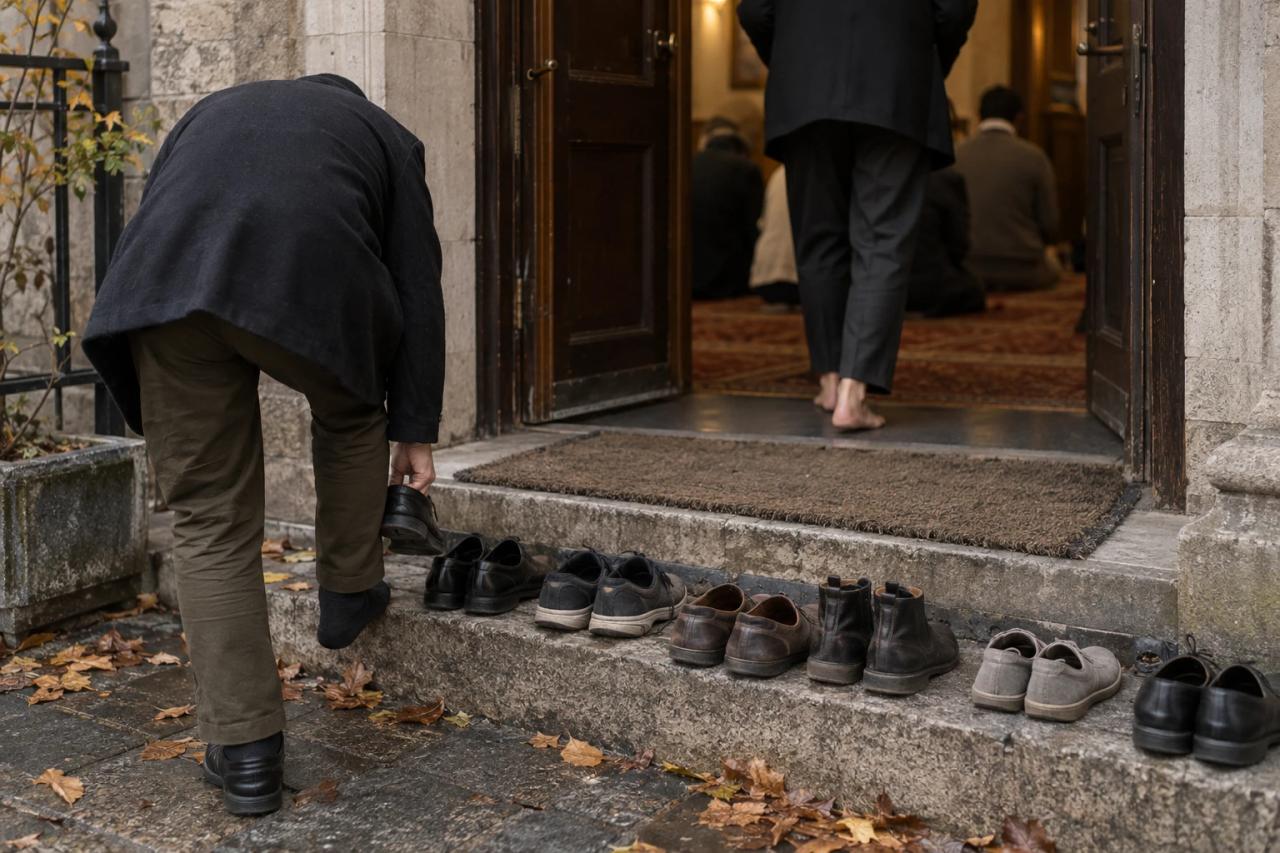
Then teach the guest's job. You take your shoes off at the door of a mosque or a Hindu temple. If a synagogue offers you a head covering, you wear it. None of that is worship — it's manners, the same way you stand when a man's wife enters the room. The line a kid can hold is clean: you honor the form, you don't adopt the substance. You don't pray the prayer or take the sacrament.
And the house rhythms don't thin out for company. Grace gets said at my table whether the guest bows his head or not. Church doesn't move for a travel tournament, and the Christmas my daughter grows up with is going to be unmistakably ours. Nobody at my table is required to join. Nobody is permitted to ask us to stop.
Mockery gets corrected on the spot, every time. A kid who learns to sneer at his neighbor's altar will sneer at yours the first day holding it costs him something.
Understand what this section is: the plan I'm building toward, not a habit I've already logged. My daughter is 19 months old, so the only thing crossing my table right now is applesauce. But the questions worth asking are the ones a father doesn't already have a tidy answer for, and I'd rather have them loaded before I need them.
Start a small kid here: why doesn't everybody on our street pray the same way? Then the follow-up that does the real work — should anybody make them? For an older one: where did your rights come from, and who has the power to take them away? That's the Declaration in two sentences, and working it out honestly takes him twenty minutes.
Go harder with a teenager. What's the strongest argument against what we believe — state it so well that I'd have trouble answering it. If a friend said faith was invented to keep people in line, what do you say back? Was Adams right that the Constitution is "wholly inadequate" for people who won't govern themselves? Why did jailed Baptist preachers want the government out of religion instead of handing it to their side?
Then the rule that makes any of it work: ask, and then shut up. A kid who hears a correction every time he opens his mouth learns to hand you the expected answer and keep his real thinking to himself. That's how a man ends up with a twenty-year-old stranger at Thanksgiving.
Let him win one now and then. When he lands a point you can't answer on the spot, say so out loud and bring it back next week.

Start with the primary documents, because they're short, free, and nobody has pre-chewed them for you. The Declaration and the Bill of Rights are a single sitting apiece. Then Washington's 1790 letter to the Hebrew Congregation at Newport — "to bigotry no sanction, to persecution no assistance" — which is the whole pluralism argument in one line a ten-year-old can repeat. Jefferson's 1786 Virginia Statute and Madison's Memorial and Remonstrance are teenage reading. So is the Farewell Address.
My daughter is 19 months old, so understand what this list is: picks and standards, not a reading log. For the youngest, David Catrow's We the Kids puts the Preamble in front of a kid with illustrations and no agenda, and a good illustrated story Bible does the other half of the work.
Elementary and middle is where story beats argument. Esther Forbes' Johnny Tremain has been handed to American kids since 1943 for a reason — a boy figures out what he's willing to lose for something. Lewis's Chronicles of Narnia teaches sacrifice before a kid has a word for it. An abridged Pilgrim's Progress still works; Bunyan wrote it in 1678 for people who couldn't afford theology.
For the teenager: Lewis's Mere Christianity, Federalist 10 and 51 on faction and ambition, Tocqueville on why religion held America's liberty together, and King's Letter from Birmingham Jail on just and unjust law.
Read the hard ones yourself first. A father who skimmed it can't defend it when his kid pushes back.
A kid who knows what he believes doesn't need his neighbor to be wrong about everything. That's the whole payoff. Fear is what you get from a boy who was never given anything solid to stand on — he either sneers at every other altar or folds into the first crowd that wants him. Confidence does the opposite. It lets him sit at a table with a Muslim classmate or an atheist roommate, ask real questions, hear the hard answer, and walk home still himself.
That confidence doesn't arrive on its own. It's built, slowly, by a father who knows what he holds and says it out loud where his kids can hear it. I love the Christian culture and values this country was built on, and I'd rather hand them over whole than hand my daughter a shrug.
So do one thing this week. Print Washington's 1790 letter to the Hebrew Congregation at Newport, read it out loud at your table, and ask who he was writing to and why it mattered.
Ask the Boss
Got a follow-up on this one? Ask the Boss.
A straight answer from the Boss, primed for this page.
Ask the BossLiked this guide?
New reviews, what I’m testing, and the verdicts about to drop. No PR-speak.
Only when there’s something new. Unsubscribe anytime · Privacy
Being a proud, present father who shows up every day isn't a compromise of strength — it's the ultimate expression of it.That’s The Boss Dad Standard.
Community