Identity-based habits work because you stop chasing outcomes and start proving a self-image through small, repeated actions — a shift backed by James Clear's research and decades of behavioral psychology. Track evidence over time instead of streaks, and the habit outlasts motivation, schedule chaos, and bad weeks.
We've all started many routines and or habits only to quit many of them by week three, usually right after an unexpected event, work or schedule change, or maybe the morning after your kid had a rough night. What finally stuck for me wasn't a stricter goal — it was building identity-based habits, a science-backed approach where you decide who you are first and then let small actions prove it. This is the framework, straight from the research, minus the fluff.
Here's the deal: I've spent literally hundreds of hours listening to podcasts, self-help videos, and have read many articles and books but when I came across Atomic Habits something was very different. James Clear's core argument is dead simple — "every action you take is a vote for the type of person you wish to become." That single line completely changed my thinking about how to build routines more than any productivity or self-help hack I've tried.
Clear breaks behavior change into three layers: outcomes (what you get), process (what you do), and identity (what you believe about yourself). Most guys — myself included, back in the day — start at the outcome layer. Lose 20 pounds. Save 10 grand. Read more books. Real talk: outcome-first goals collapse the second life gets messy, and with a 14-on/14-off work schedule, my life gets messy on a predictable cycle.
Identity-based habits flip the order. You decide who you are first — "I'm a dad who trains," "I'm a man who shows up" — and then let small, repeatable actions cast votes for that identity. Clear's work, built on behavioral psychology research going back decades, found that habits rooted in self-image survive disruption because you're not chasing a finish line. You're reinforcing who you already decided to be, one rep at a time. Speaking of reps, if you are thinking of starting or have already started a new workout routine be sure to check out our essentials supplement stack.
Your brain doesn't experience "I did 10 pushups" the same way it experiences "I am becoming a stronger man." That distinction is neurological, not motivational, and it's why identity-based habits stick when generic goals don't.
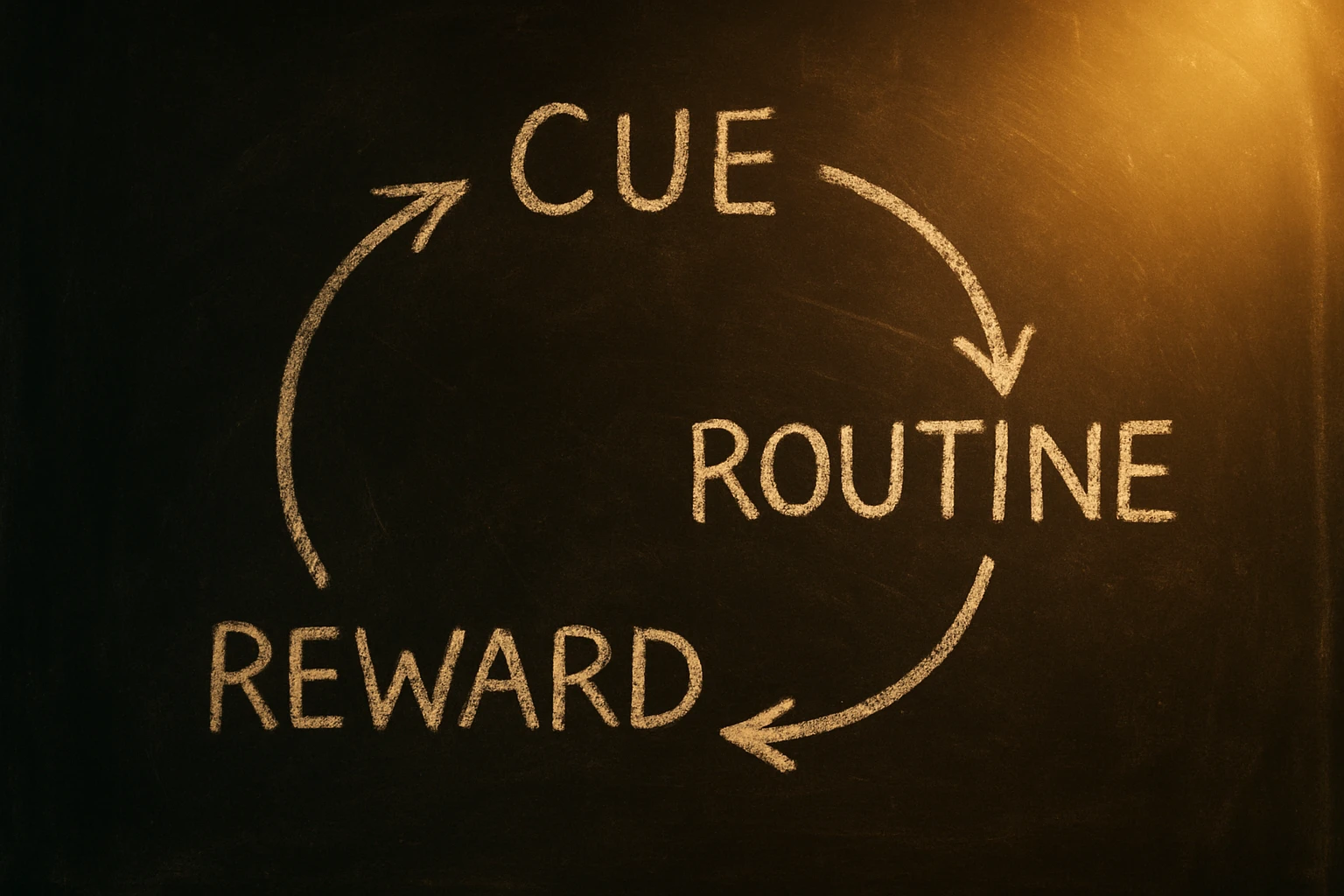
Charles Duhigg's habit-loop research, popularized in The Power of Habit, showed the basal ganglia — the part of your brain handling automatic behavior — encodes routines as cue-routine-reward loops that eventually run without conscious thought. Repeat an action tied to a self-belief long enough, and your brain stops treating it as effort and starts treating it as identity confirmation.
Then there's Daryl Bem's self-perception theory, first published in 1972, which found people infer who they are by observing their own behavior — the same way they'd size up a stranger. Do the thing enough times, and your brain builds a case file of evidence. Skip it, and the case file gets thinner. That's not a metaphor; it's how the brain resolves cognitive dissonance between belief and behavior, usually by updating the belief to match the pattern of action.
Bottom line: small, consistent reps don't just build a skill — they build a self-concept. Miss a workout and tell yourself "I'm just tired today" and you protect the identity. Miss it and tell yourself "I guess I'm not really a training guy" and you've cast a vote against yourself. The neuroscience doesn't care about your intentions — it only counts the votes.
1. Decide the identity before the routine. Clear calls this "deciding the type of person you want to be" — not a vague wish, a specific label. "I'm a dad who reads to his kid every night" beats "I want to be more present," because a label is falsifiable and a wish isn't.
2. Make the first vote embarrassingly small. BJ Fogg's Tiny Habits research out of Stanford's Behavior Design Lab found tiny actions — two pushups, one page, one glass of water — build consistency faster than overly ambitious ones, because the brain doesn't resist small asks. Small reps still count as votes.
3. Stack the new identity onto an existing routine. Habit stacking — pairing a new action right after an established one — uses the existing cue-routine-reward loop as scaffolding instead of building one from scratch. I stack my 15-minute reading habit onto my daughter's bedtime, because bedtime happens every night no matter what else is going on.
4. Track evidence, not streaks. A missed day breaks a streak; it doesn't erase your evidence file. Phillippa Lally's 2010 study out of University College London found real habit formation averages 66 days and varies wildly by person — streak-chasing sets you up to quit the day math doesn't cooperate.
5. Let identity absorb setbacks instead of erasing them. Kristin Neff's self-compassion research shows people who treat a slip as data, not failure, return to the behavior faster than people who treat it as proof they're a fraud. One missed rep is a bad data point, not a verdict.
SMART goals — Specific, Measurable, Achievable, Relevant, Time-bound — have their place. I used them running my construction company, because a renovation job needs a deadline and a budget, full stop.
But SMART goals are outcome-obsessed by design, and outcome obsession is exactly what identity-based habit research says fails for personal change. A SMART goal says "lose 15 pounds in 90 days." Hit day 91 short by two pounds, and most guys call the whole thing a failure — even if they built real muscle and better habits along the way.
Identity-based habits ask a different question: not "did I hit the number," but "did today's action match the man I said I'd be." That reframe matters more for men specifically, because a lot of us were trained to measure worth by output and results, not process. It's an easy trap — chase the scoreboard, ignore the man doing the scoring.
The research-backed middle ground: use SMART goals for projects with real deadlines — the roof needs to be done by fall — and use identity-based habits for who you're becoming as a father, husband, and man. One measures a task. The other measures a life. Confusing the two is how guys white-knuckle a 12-week program, hit the deadline, and slide right back to where they started because nothing about their self-image ever changed.
Here's a system actually worth trying if you have one too many half-finished habit trackers cluttering a kitchen drawer. Call it the 3-Column Ledger, and it takes about 90 seconds a day.
Column one: the action. Whatever small, specific thing you did — ten minutes of reading, a home-cooked dinner, five minutes of prayer before the day starts. Column two: the identity vote. Write the one-sentence identity that action supports — "I am a dad who's present," "I am a man who follows through." Column three: the evidence count, a running tally of how many votes you've cast for that identity this month, not how many days in a row.
Every 30 days, review the ledger and ask one question: does the evidence match the man I said I wanted to be? Not "did I hit 30 for 30" — the evidence count, not the streak, tells the real story. A guy with 22 votes out of 30 during a month with two weeks offshore has stronger proof of identity than a guy who ran a perfect streak during an easy month and quit the second life got hard.
At 90 days, read your identity statement out loud. If it still sounds true, keep going. If it sounds like something you're forcing, the identity was probably too big or too vague to begin with — shrink it and restart the ledger. Sometimes good enough is good enough, and a realistic identity you can actually sustain beats an aspirational one that collapses by February.

Experts who study behavior change keep flagging the same handful of ways identity-based habits fall apart, and I've personally tripped over at least three of them.
Failure point one: picking an identity too broad to act on. "I want to be a better man" isn't a habit target, it's a mission statement — it gives your brain nothing specific to vote for. Narrow it: "I'm a man who calls his kid before bed every night I'm working."
Failure point two: all-or-nothing thinking. Research on habit relapse consistently shows one missed day rarely derails long-term change — but two missed days in a row, treated as proof of failure, usually does. Guard the second day harder than the first.
Failure point three: chasing an identity that isn't actually yours. Clear's own research warns against adopting an identity because it sounds impressive rather than because you genuinely want it. If you're building "disciplined athlete" because a social media feed told you to, not because you actually care, the votes won't hold up under real pressure.
Failure point four: no accountability structure. Self-perception theory works because you're watching your own behavior — but a spouse, a brother, or a men's group watching too accelerates the shift, because now there's outside evidence backing your internal case file.
Failure point five: reviewing progress by feeling instead of by the ledger. Motivation lies to you on hard days. The evidence count doesn't. Open the ledger, check the actual votes, and let the data — not the mood — call the shot.
Real talk: you don't need another 90-day challenge or a fresh notebook you'll abandon by March. You need one identity, small enough to act on today, tracked honestly enough that the evidence can't lie to you. Pick one label — dad who's present, man who follows through, husband who shows up — and cast your first vote tonight. Not next Monday, not after the holidays. God can move mountains, but you'd better bring a shovel, and the shovel here is a 90-second ledger entry and one small rep, repeated until the man you're becoming and the man you already are turn out to be the same guy.
Common Questions
Liked this guide?
One email when there's actually something worth saying. Plus dad-tested stuff before they go up.
Reviews
Guides

The Science Behind Dad Brain And How Fatherhood Changes You
Fatherhood doesn't just change your schedule — it physically rewires your brain. Here's the science every new dad needs to understand.

Razor Rash? Here's Our #1 Shaving Hack for Men.
Sink shaving is costing you time and wrecking your neck. Here's the one switch that kills razor rash and buys back 5–8 minutes every morning.

Faith, Fatherhood & the Man You Should Become First
Sustainable fatherhood isn't built on behavior alone — it's built on identity. Here's why the work on yourself had to come first.

Ask the Boss
Want tested gear that fits what this guide covers? Ask the Boss.
— Boss Daddy Gear